


All catholic church keeps in its interior an incalculable treasure that gives meaning to the whole architectural space. We are talking about the tabernacles that are the center of attention of all eyes and the beating heart of the church. When the faithful enter a sacred precinct they instinctively look for that flash of light or that prominent volume that tells them where the real presence resides. In this sense, aesthetics and functionality must go hand in hand to create pieces worthy of their sublime purpose.
Talking about tabernacles implies entering into a discipline where theology and goldsmithing are masterfully blended. Every detail in tabernacle design has a purpose and nothing is left to chance. For the people in charge of acquiring these important pieces, understanding the visual message is truly fundamental.
Throughout this article we will explore how the design of tabernacles influences devotion and why the tabernacle door constitutes the most relevant iconographic element of all the goldsmith's work.
The acquisition of these liturgical elements represents a momentous decision for any parish or cathedral. Sacred art committees and pastors know that in choosing tabernacles they are selecting a work that will last for many, many generations. This great responsibility is shared by churches with deep historical roots in Spain and by dynamic and growing communities throughout the United States.
The design of tabernacles should respond fluidly to the architectural style of the church without ever losing its catechetical essence. In traditional parishes, a baroque tabernacle with angels fits perfectly with a profuse and detailed altarpiece. On the contrary, in more contemporary spaces a refined aesthetic is usually sought where the door of the tabernacle takes all the visual prominence by means of a central relief or very well defined enamel.
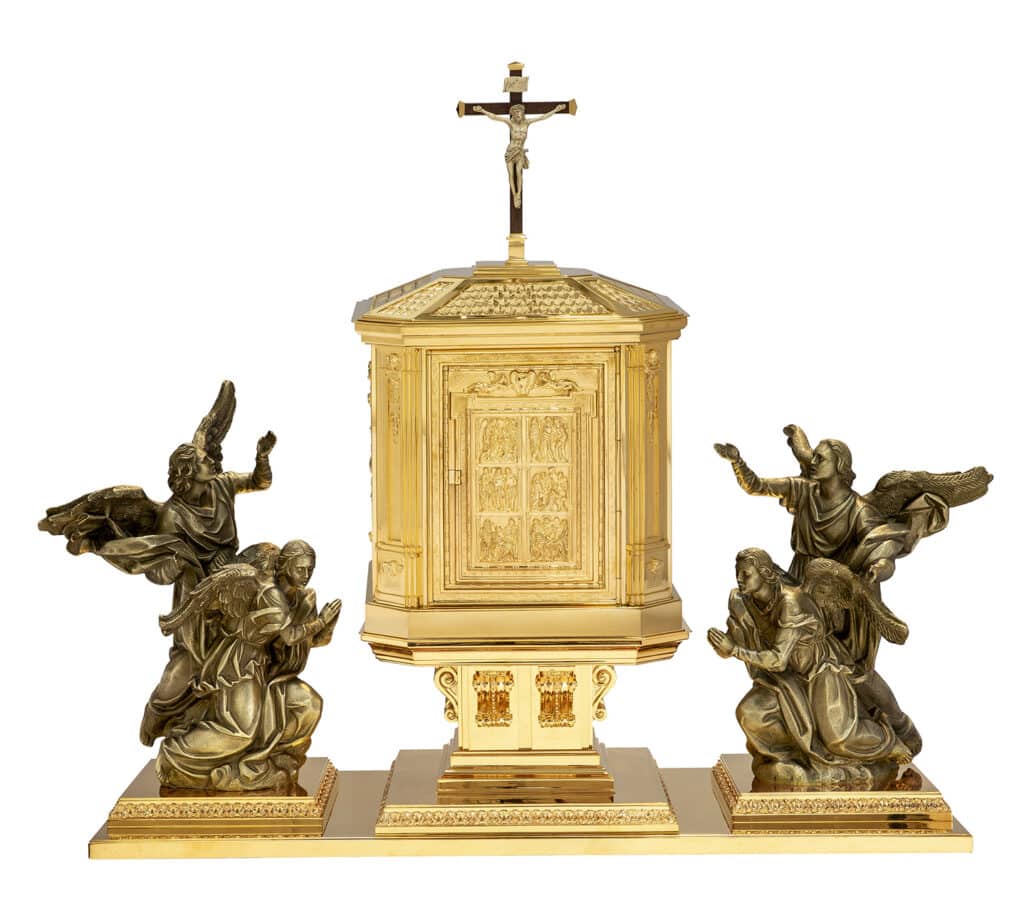
It is fascinating to observe how sacred art transcends all geographical boundaries. Eucharistic devotion is universal and the language of art serves as a magnificent bridge to unite different cultures under one faith. Impeccable tabernacle design uplifts the viewer's soul whether praying in a rural Spanish hermitage or a vast American basilica.
To understand the immense value of these liturgical pieces today, it is worth taking a look at the Church's past. During the first centuries of Christianity the Eucharistic species were kept in small discreet containers due to the constant persecutions. With the peace of Constantine and the subsequent development of the sacred liturgy, much more elaborate and visible tabernacles began to appear. The Middle Ages saw the appearance of Eucharistic doves suspended above the altar itself and beautifully decorated wall cabinets.
The Council of Trent marked a definitive turning point for ecclesiastical architecture. It was determined that the tabernacle had to be located in the center of the main altar, which prompted a spectacular development in the design of tabernacles. Artists and architects began to conceive these works as small sacred temples within the main temple. This gave rise to architectural forms with columns, domes and pinnacles that masterfully exalted the majesty of the sacrament.
Today we find a rich and vibrant stylistic variety. There are communities that prefer a mozarabic style tabernacle San Isidro to evoke in a nostalgic way the spirituality of the first peninsular centuries. Others, however, opt for elegant Gothic or Renaissance lines. In spite of these aesthetic differences, in all of them the door of the tabernacle remains firm as the main canvas where the master goldsmith captures the Gospel message.
If the tabernacle is the dwelling of God among men, its main entrance represents the mystical frontier between our world and eternity. The tabernacle door is not a simple metal or carved wooden lid to secure a closed enclosure. It is an authentic invitation to deep prayer and a visual reminder of the infinite mystery that it jealously guards. When the priest opens that golden door, the central miracle of our Christian faith is revealed.
For this reason, the design of tabernacles pays exquisite attention to this front surface. The great master craftsmen specialized in church tabernacles The richness of the materials used sincerely reflects the love and respect of the Christian community for the Eucharist. The richness of the materials sincerely reflects the love and respect of the Christian community for the Eucharist. The use of gold, silver and semiprecious stones in the door of tabernacles does not represent a vain ostentation but a humble and sincere earthly homage to the immense celestial grandeur.
The iconography masterfully captured on the tabernacle door constitutes a true visual catechesis for all those present. The faithful can read and interpret in metal the great mysteries of salvation history. We will now analyze some of the most common and beloved ornamental motifs.
The sacred Pelican is one of the most beautiful and ancient liturgical symbols known. Tradition has it that this noble bird wounds its own breast to feed its young with its blood when the daily food is lacking. This touching image perfectly represents the redemptive sacrifice of Christ who nourishes his whole Church with his body and his precious blood.
The victorious Paschal Lamb frequently appears reclining on the book of the seven seals or carrying the banner of the resurrection. His presence evokes the ultimate innocence, voluntary immolation and the definitive triumph of light over death.
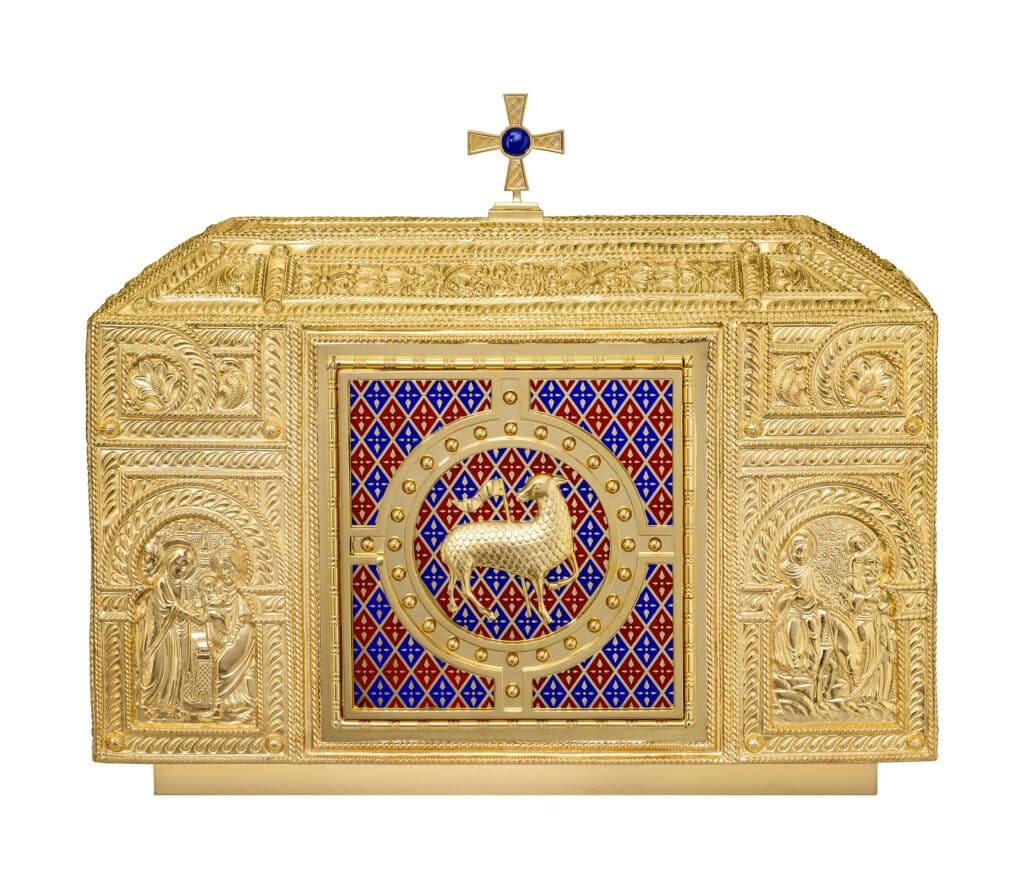
Gospel scenes also occupy a tremendously prominent place in tabernacle design. The moving Supper at Emmaus, the amazing miracle of the multiplication of the loaves and fishes or the institution of the Last Supper remind us of the convivial and profoundly miraculous character of Holy Communion. On many occasions the parish community chooses to represent a splendid Pantocrator or the gentle Good Shepherd patiently guiding his flock.
The traditional chrism and the sacred monogram JHS always accompanied by the Greek letters Alpha and Omega are fundamental typographic elements that resoundingly reaffirm the divinity of Jesus Christ as the absolute beginning and immutable end of all created things.
To facilitate the rewarding work of purchasing committees and parish leaders, we have prepared a very useful and visual scheme. Evaluating the different and varied tabernacle design options is much easier when their main features are contrasted at a glance. In this comprehensive table we present three representative approaches that help to visualize perfectly how the tabernacle door defines the character of the entire artistic ensemble.
| Predominant style | Frequent materials | Door Symbology | Ideal liturgical environment |
| Classic Renaissance | Gilded bronze and embossed silver | Scenes of the Last Supper or the Lamb | Cathedrals and historic temples with major altarpieces |
| Romanesque and Mozarabic | Noble metal with fire enamel appliqués | Pantocrator and abundant geometric or floral motifs | Ancient hermitages, stone chapels and austere monasteries |
| Contemporary Style | Polished brass, satin-finished steel and smooth textures | Golden spikes bunches of grapes or a very simple cross | Newly built parishes and university chapels |
This revealing scheme demonstrates that tabernacle design is by no means static or boring. Each material selected and each relief forged into the tabernacle door brings a totally different nuance to the overall prayerful atmosphere of the church.
Behind every exciting liturgical acquisition there is a beautiful story of deep devotion and a commendable community effort. Listening carefully to the experiences of those who have already gone through this process enriches our own perspective and wonderfully humanizes a management that a priori could seem purely technical.
From a vibrant young community in the state of Texas, the head of the liturgical art committee relates his personal experience in renovating the entire presbytery. "We were very clear that we were looking for a piece that would immediately capture the attention of our young parishioners without losing any of the solemnity. As we perused the extensive catalog, we were completely captivated by the exceptional craftsmanship. The tabernacle door we finally chose has a beautiful relief of the Good Shepherd that conveys a great deal of inner peace. The visual impact on our parish has been truly extraordinary and we have joyfully noticed a considerable increase in the amount of time people spend in silent Eucharistic adoration".
On the other hand, in a U.S. city, the pastor of a recently and carefully restored historic church shares a subtly different but equally enriching approach.
"Our beloved temple dates back to the seventeenth century and logically we needed something very much in keeping with that imposing architectural magnitude. Acquiring a neo-Romanesque tabernacle with angels was an absolutely resounding success for the entire parish. The classically cut tabernacle design has the immense virtue of blending into the surrounding architecture as if it had actually always been there from day one. The fine and delicate hand-chiseled details on the tabernacle door sincerely amaze all daily visitors.s".
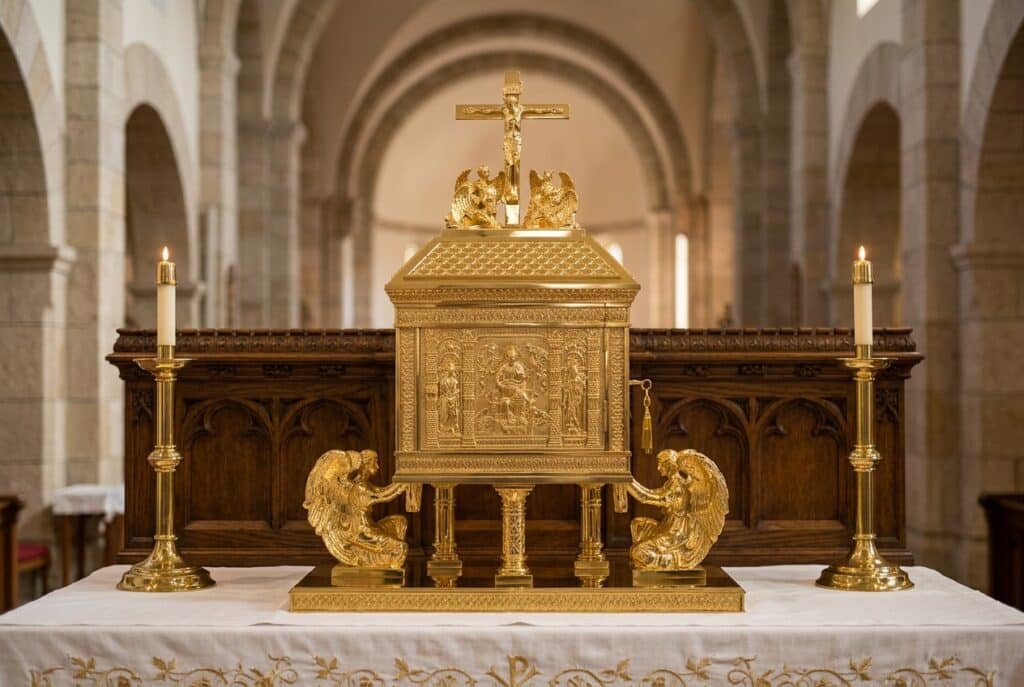
These heartfelt voices show us that choosing tabernacles goes far beyond coldly consulting the pages of a commercial catalog. It involves a profound process of spiritual discernment in which the work that best resonates with the collective soul of the Christian assembly is sought.
When investing funds in these marvelous works of sacred art, unquestionable beauty must always go hand in hand with maximum security and perfect practical functionality. A truly excellent design of tabernacles includes both a splendid exterior appearance and a highly dignified and one hundred percent protected interior.
Perimeter armoring is a non-negotiable aspect in this day and age. The general structure must be extremely robust and generally built with resistant steel or metals of very high hardness in its internal core. The door of tabernacles, besides being extremely beautiful, has the unavoidable obligation of having locks of the highest precision and solid invisible or strongly reinforced hinges that radically prevent any undesired attempt of profanation. The beautiful keys are usually carefully crafted pieces that are very often kept in special boxes designed to match the general gold work of the altar.
The sacred interior requires exactly the same care as the visible exterior. Strict liturgical regulations strongly advise that the divine receptacle be lined with a very precious material that is always clean. Very often an impeccable bath of pure twenty-four carat gold is used. This delicate space must be completely watertight around the edges in order to efficiently protect the sacred forms from the dreaded humidity, environmental dust and the always annoying insects, thus guaranteeing an impeccable and lasting Eucharistic conservation.
Finally, the overall physical dimensions must be meticulously calculated before the final step is taken. The exact number of ciboria that the parish will need to hold on a day-to-day basis must be foreseen in advance. A superficial or erroneous calculation in the design of tabernacles can result in a totally insufficient space to cope with the days of large and busy liturgical celebrations.
The complex production of tabernacles is still today a marvellous fine art redoubt where modern frenetic haste has no possible place. Each elaborate tabernacle door requires weeks and sometimes months of professional and exclusive dedication. The hardened hands of master silversmiths, expert chiselers and virtuoso enamelers work with the same devotion that was shown by the patient illuminating monks of the distant European Middle Ages.
Financially supporting this demanding type of historic craftsmanship means actively protecting a priceless cultural and spiritual heritage of immense proportions. Established companies specializing in fine religious goldsmithing are miraculously keeping alive ancient manual techniques that would otherwise disappear forever. By acquiring tabernacles of supreme quality, churches not only visually embellish their altars but also become true patrons of contemporary sacred art, ensuring that future generations of believers inherit aesthetic marvels fully comparable to the finest jewels of the past.
The continuous care of these sacred objects is also essential. With the inevitable passage of time and the logical exposure to candle smoke or aromatic incense, metals can slightly lose their original luster. Proper preventive maintenance and regular professional cleaning ensure that the design of tabernacles always looks absolutely resplendent, honoring eternally and relentlessly their primary liturgical function.
Ultimately the tabernacle design stands as a sublime and unparalleled expression of sincere faith and earthly beauty. The sturdy tabernacle door constantly and wordlessly reminds us of the majestic grandeur of the Eucharistic mystery by graciously inviting us to pause for a moment amidst the overwhelming daily noise in order to contemplate the purely eternal. Each meticulous chiseling is a heartfelt prayer carved in metal, a remarkable human effort to make the invisible wonderfully tangible.
Explore our extensive catalog of beautiful pieces and purchase with confidence the liturgical piece that will be the center of your congregation's attention and will last for generations.

