


The ecclesiastical architecture is not simply erecting walls or designing religious buildings. It is the art of creating spaces that invite recollection, prayer and encounter with the sacred. Each church, chapel or oratory must convey a deeper truth, that something greater dwells there.
But what makes a space truly sacred?
Ecclesiastical architecture implies sensitivity, experience and a clear intention, facilitate dialogue between God and his people. Sacred architecture is built with symbols, proportions, light and materials that not only decorate, but also communicate. It is not only about aesthetics, it is about faith made form.
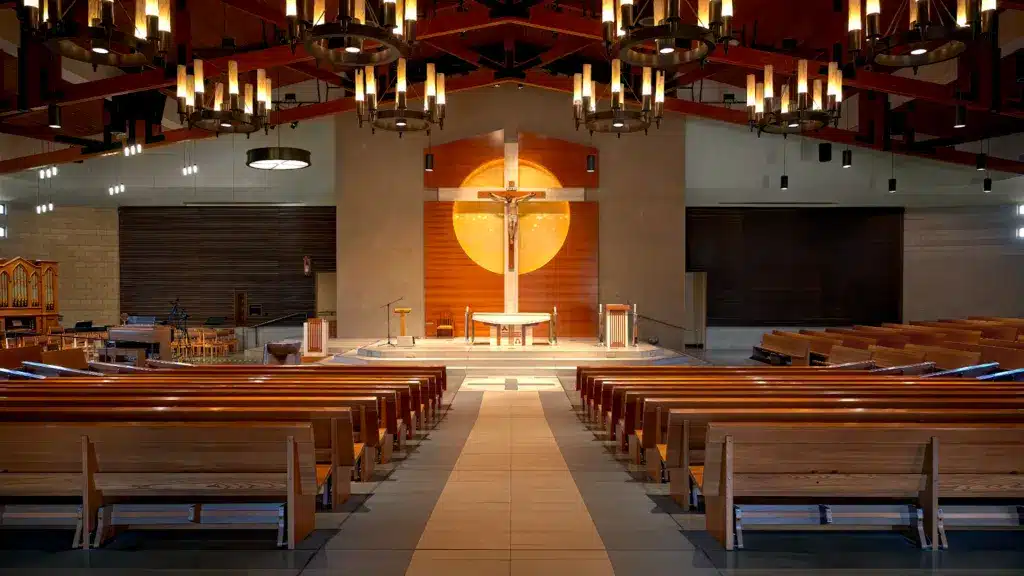
Many churches follow the latin basilica plant, The central nave guides the gaze towards the altar, traditionally oriented to the east as a symbol of the Resurrection of Christ.
Others take the form of centralized cruciforms, The Greek cross or the tetraconch plant, present in Byzantine architecture, represent cosmic balance and unity.
Light doesn't just illuminate: it reveals. That's why controlling how it enters light in a christian church is key. Skylights, stained glass windows or small openings create an atmosphere of recollection. The direction of the light can guide prayer and focus attention on the altar or tabernacle.
Churches such as St. Marien (Germany) or the Capilla del Retiro (Chile) are examples of how contemporary architecture manages to unite simplicity, silence and light in the same space.
Stone, wood, brick or metal: each material has a symbolic charge. The Virgen del Camino Church, in León, uses exposed concrete to convey austerity, firmness and liturgical presence. Other contemporary designs use wood or natural stone, evoking warmth, roots and a link with creation.
A church is not just a place to look at, but to participate. The design should encourage participatory liturgy, with pews arranged in a semicircle or around the altar. Elements such as the liturgical furnishings (altars, ambo's, kneelers) must be visually and functionally integrated into the architectural ensemble.
At Granda we offer customized solutions of liturgical furnishings that adapt to every style and pastoral need.
Symmetry is not only a formal matter: it helps to create harmony and a sense of transcendence. Central nave, defined axes, rhythmic repetition of arches or columns... Everything contributes to structure the sacred space as an ordered place, reflecting the beauty of the Creator. The symbolic elements as images, stained glass or reliefs enrich this message without saturating it.
The ecclesiastical architecture has evolved over the centuries, adapting to the historical, cultural and liturgical contexts of each era. However, the same objective persists in all styles: making the invisible visible, expressing faith through space. Below, we review the main styles that have marked the history of sacred art and continue to inspire architects and religious communities today.
The Romanesque style flourished between the 11th and 13th centuries, at a time of spiritual and cultural consolidation in Europe. Its churches are recognized by the thick walls, semicircular arches and stone vaulting, elements that convey a sense of shelter, stability and inner strength.
This architectural language expresses faith as something solid and lasting. The stone, almost always local, reflects the link between the community and its environment. Romanesque temples are places of silence, where the half-light invites to prayer and time seems to stand still.
Emblematic examples of this style can be found at San Martín de Frómista (Spain) or at Sainte-Foy de Conques (France), two temples that embody the spirit of humility and firmness of medieval Christianity. In contemporary architecture, many oratories and rural chapels reinterpret this aesthetic by means of masonry walls and simple structures, adapted to modern materials such as concrete or natural stone.
The gothic arose in the 12th century and completely transformed the conception of sacred space. Faced with the weight of the Romanesque, the Gothic seeks to raise your eyes to the sky. Its ribbed vaults, flying buttresses and large stained glass windows fill the interiors with light, turning the architecture into a spiritual experience.
This style embodies the idea that divine light penetrates the material world. Walls cease to be opaque and become translucent membranes of color. Cathedrals such as Notre-Dame de Paris, Chartres o Lion are examples where architecture becomes built theology: proportion, verticality and luminosity at the service of faith.
Today, many neo-Gothic churches-especially in the United States and Latin America-keep this tradition alive. Their verticality and structural rhythm continue to inspire restoration and new design projects, adapting the Gothic language to contemporary materials such as steel or structural glass.
The Byzantine art was developed in the Eastern Empire and is characterized by its majestic domes, centralized floor plans and gilded mosaic decorations. This style conceives the temple as an image of heaven: an enveloping space where the believer feels immersed in the divine mystery.
In Byzantine churches, light does not enter directly: it reflects off the mosaics, creating a golden glow that symbolizes the glory of God. Works such as Saint Sophia in Istanbul or Saint Vital of Ravenna are paradigmatic examples of this theological symbolism made architecture.
In the 19th and 20th centuries, the style neo-Byzantine recovered these forms in western temples. Cathedrals such as Westminster Cathedral in London or the Sacré-Cœur Basilica in Paris reinterpreted Eastern Christian language in a modern key. Today, many university chapels and monastic oratories take up these elements - domes, gilded backgrounds, mural iconography - to create spaces that convey serenity and transcendence.
The 20th century brought a profound change in the way liturgical space was understood. Modern architecture shed excessive ornamentation to focus on the essentials: light, proportion and silence. Inspired by architects such as Le Corbusier o Marcel Breuer, Modern temples seek spirituality to emerge from the purity of the forms.
The Notre-Dame du Haut Chapel in Ronchamp (France) or the church of San Francisco de Sales in Michigan (USA) are milestones of this contemporary vision: open spaces, curved walls, directed light and noble materials such as concrete or natural stone.
In this style, the beauty is born of simplicity. The absence of ornamentation is not emptiness, but an invitation to inner silence. Modern and minimalist architecture has shown that sacred art does not depend on the amount of decoration, but on the symbolic depth of the space.
Contemporary ecclesiastical architecture is not limited to copying a historical model. On the contrary, dialogues with the past to express the faith of the present. Romanesque (for its robustness), Gothic (for its verticality), Byzantine (for its symbolism) and modern (for its simplicity) elements can coexist in the same project.
Each community and each architect chooses the language that best reflects its spirituality and its environment. What is essential is not the style, but that the temple invites recollection, encourages participation and speaks the universal language of beauty.
Before designing a sacred space, it is important to understand its context: location, history, local culture, indigenous materials and pastoral needs of the community.
From the beginning, the design should contemplate the presence of altars, ambo, seat, tabernacle and other elements. These are not added later, but are born with the space. At Granda we can help you achieve this integration with custom liturgical designs.
It is not enough to illuminate: you have to do it with intention. Play with natural and artificial light to guide, highlight and reveal. Use liturgical colors (white, purple, red, gold) according to the cycle and the message to be transmitted.
Parish life is not limited to worship. Community rooms, catechetical spaces or private prayer areas must be integrated coherently into the architectural ensemble.
All ecclesiastical architecture must comply with the norms of the Vatican Council II and ecclesiastical documents on liturgy. This ensures that the space facilitates worship, participation and communion.
You can also read our article ▶ Interior design for churches
To design a church is to design a space for the soul. Proportion, light and matter become instruments of prayer. When architecture meets sacred art, the result transcends the functional and becomes presence.
If you are thinking of building, renovating or restoring a temple, having a team specialized in ecclesiastical architecture and liturgical art guarantees a project where faith takes shape.
You can learn about some examples and customized solutions in Granda's furniture and sacred art section, where every space is conceived to reflect the beauty and truth of the sacred.
Are you thinking of renovating your sacred place or building a new one?
Contact with us and take the first step towards a meaningful space.

