


From the earliest Christian temples to contemporary churches, the religious statues have been much more than an ornamental element. They represent faith made matter, a tangible way of expressing the invisible and bringing the faithful closer to the divine mystery. The sacred decorationunderstood as the art of embellishing the spaces of worship, finds in sculpture one of its most powerful languages.
The presence of a statue in a temple does not respond only to aesthetic desire. Every form, every gesture and every color is loaded with symbolism. An image of Christ on the cross, a Virgin in prayerful pose or a saint with his specific attributes convey profound theological ideas that for centuries have helped millions of people to understand and live their faith.
The first Christian representations appeared in the Roman catacombs, where believers, still persecuted, painted symbolic scenes from Scripture: the Good Shepherd, the fish, the anchor. With the Constantinian peace and the spread of Christianity, sacred art began to develop freely, giving way to the first liturgical sculptures.
The fact of representing Christ, the Virgin or the saints was not an isolated artistic gesture, but a theological consequence of the Incarnation. If God became man, his image could be represented. This is the origin of Christian sculpture: not as an object of adoration, but as a means of contemplation. The religious sculptures became a bridge between the earthly and the divine, a silent presence that invited recollection.
Throughout the centuries, sacred sculpture assumed different functions. In the Middle Ages, it served to educate illiterate people, visually narrating episodes from the Bible. In the Renaissance, the beauty of the human body regained prominence as a reflection of divine perfection. In the Baroque, drama and movement sought to move the soul and awaken devotion. Each era interpreted the Christian mystery with its own artistic language.
All statue or religious image communicates a message. Christ the Redeemer, with open arms, represents the embrace of mercy. The Virgin Mary, with joined or outstretched hands, symbolizes intercession and welcome. St. Joseph, protector of the family, is usually shown with the Child in his arms, a sign of spiritual paternity. The martyr saints carry palms; the doctors, books or pens; the founders, habits of their orders.
In the sacred decorationThese figures not only embellish the space, but also direct the gaze towards the mystery. A statue next to the altar underlines the presence of the patron saint. An image in a side niche offers a point of personal prayer. And a sculptural group in the presbytery can narrate, without words, the history of salvation.
Sacred art, in its essence, is a catechetical language. Sculpture teaches, moves and evangelizes. It is not an ornament, but a form of silent preaching. That is why, in the Catholic tradition, images have been carefully regulated: their beauty must lead to goodness and truth, never distract or trivialize the liturgical act.
The liturgical sculpture has a double function. First, it serves for prayer and worship, facilitating the spiritual concentration of the faithful. Secondly, it contributes to the aesthetic unity of the church, harmonizing with the altar, altarpieces, stained glass windows and sacred ornaments.
In the liturgy, everything is designed to guide the soul towards the sacred. Architecture, music, light and sculpture form a coherent whole. The presence of a statue should not be an added element, but an organic part of the space. Hence the importance of its placement, size and materials. An image of Christ on the cross should visually dominate the presbytery, while a Marian carving or a saint can occupy side chapels or pilgrimage points within the church.
In recent years, sacred art workshops have recovered the idea of designing each work in dialogue with the space that will host it. The creation of religious statues is conceived today as part of an integral project: sculpture is not improvised, but its relationship with architecture, light and liturgy is studied.
The history of religious sculpture is closely linked to the materials available in each era. Wood was the most common support in the Middle Ages, for its warmth and ease of carving. Marble and stone dominated Renaissance art, symbol of purity and eternity. The Baroque brought with it polychromy and gilding, accentuating realism and emotion.
Today, tradition coexists with innovation. Today, we also use light materials, reinforced resins and advanced casting techniques that allow us to transport the works anywhere in the world without losing quality or detail. We are also experimenting with new finishes that imitate the texture of bronze or the nobility of marble with less weight.
The important thing, however, is still the spiritual message. The material is only the medium. The true work of art is that which succeeds in transmitting faith, serenity and beauty. A good religious sculpture does not need ostentation: balance, harmony and expression are enough.
Although styles change, the essence of the sacred art remains. The desire to represent the divine, to elevate the spirit and to teach through beauty remains as alive as in centuries past. In recent decades, there has been a renewed interest in quality religious statues, crafted by artists and workshops that combine craft, theology and liturgical sense.
An example of this continuity can be found in the contemporary sculpture projects carried out in different temples around the world, where the aim is to integrate sacred art with modern architecture. Some of these works, commissioned to workshops with long experience in the liturgical field, demonstrate that tradition is not at odds with innovation.
In churches in the United States and Europe, for example, sculptural ensembles designed with a contemporary visual language, but faithful to the Christian spirit, have been installed. In these works, proportion, serenity and gesture remain the main elements. The religious statue continues to be a presence that speaks without words, a silent reminder of the sacred.
In a temple, each element has a purpose, and the elements of a temple are religious statues are not an exception. Their presence must be harmoniously integrated into the architectural and liturgical ensemble. It is not just a matter of placing a figure in a visible spot, but of creating a dialogue between the sculpture, the light, the altar and the prayer space.
When an image is correctly placed, it guides the gaze without imposing itself. A statue of Christ or the Virgin can be placed next to the presbytery to emphasize the centrality of the mystery being celebrated. On the other hand, the saints or patron saints usually occupy side chapels or secondary altarpieces that invite personal devotion. Position, size and lighting directly influence how the faithful perceive their spiritual presence.
The contemporary projects of sacred decoration are based on this understanding of space. The sculpture is not an added object, but an essential component of the sacred atmosphere. The natural light, the color of the wall, the texture of the floor or the orientation of the altar condition the visual and symbolic impact of the statue. Specialized workshops work together with architects and liturgists to ensure that each work is adapted to the destination site and retains its spiritual meaning.
The Granda art has crossed borders, with sculptures present in temples in America, Europe and Asia. In the United States, Guatemala or Scotland, the religious statues made by his workshops demonstrate the ability to unite tradition and modernity without losing the spiritual sense that characterizes sacred art.
Recent examples include:

A sculpture of resin finished in bronzeThe painting, 166 cm, depicts the founder of Opus Dei with a gesture of recollection and humility. The work combines a realistic technique with a texture that highlights the expressiveness of the face and the detail of the embroidery on the chasuble.
It was conceived for an oratory in Virginia, where an image was sought that reflected the spirit of service and dedication to the world.
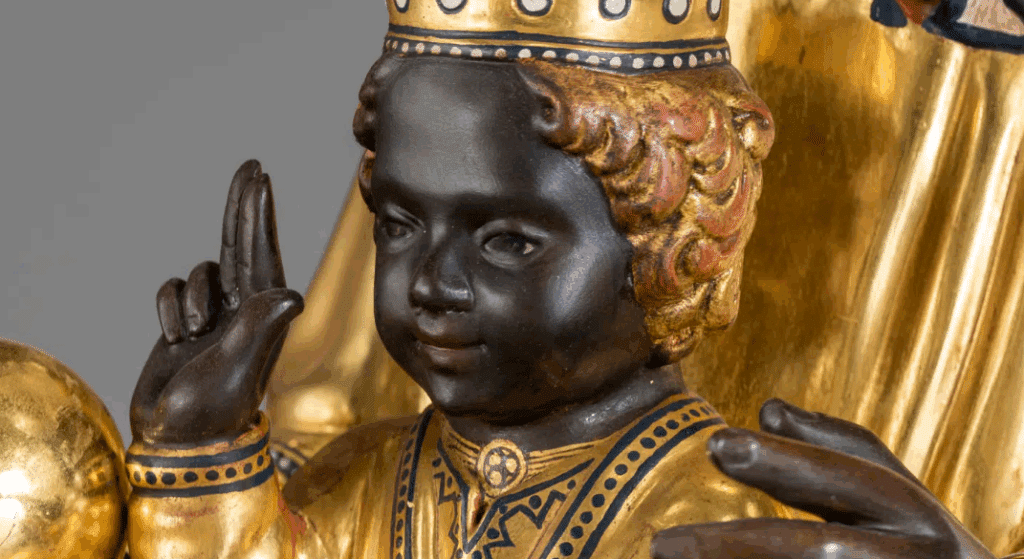
Reproduction in gilded and engraved wood of the famous Catalan dedication, made for the chapel of Belen Jesuit Preparatoy School in Miami. The piece preserves the solemnity of the Spanish tradition with meticulous finishes that highlight the colors, geometric shapes and elegance of the ensemble. It is an example of how European tradition is harmoniously integrated into North American sacred spaces.
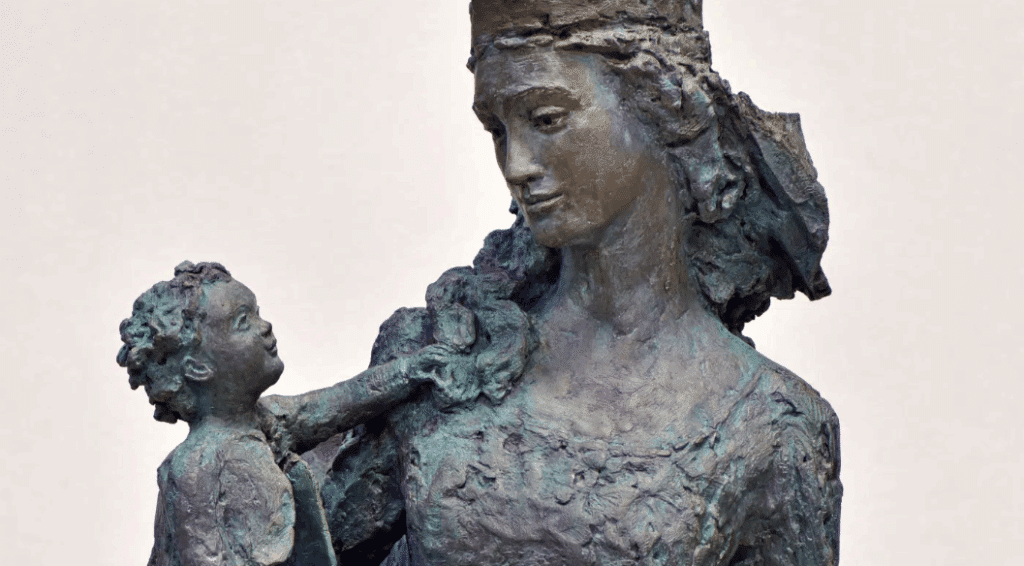
A sculpture of cast bronze installed in a chapel in Scotland, where the texture of the metal brings a sense of strength and spirituality. The Virgin appears in an attitude of tenderness, with the Child in her arms, creating a scene of visual dialogue between mother and child. It is an example of how contemporary religious sculpture can maintain classical spirituality without losing modernity.
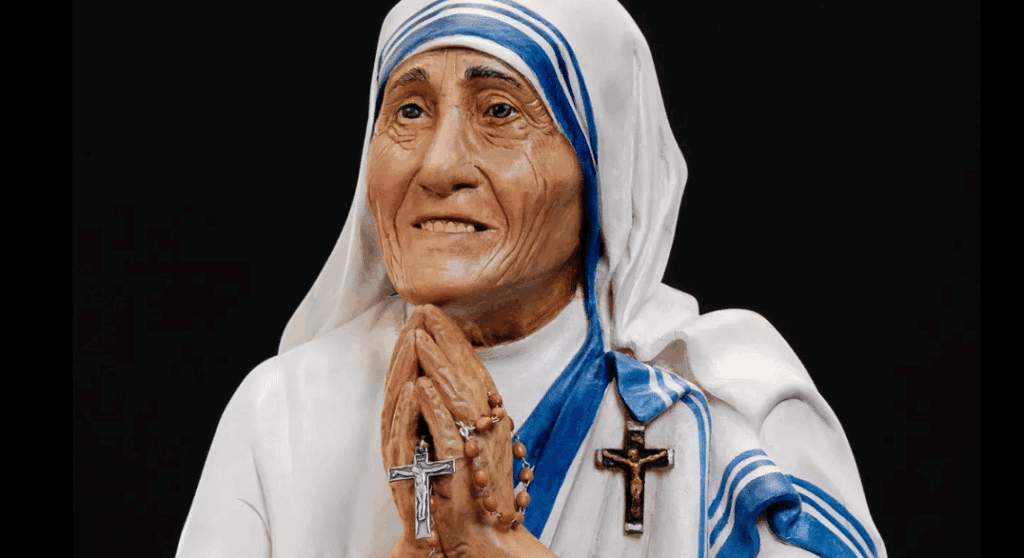
Round sculpture made of linden wood carved and polychromed, created as a special work for the Sydney Cathedral, Australia. The piece, 90 cm high, is part of a sculptural group of holy women commissioned to GRANDA for the temple.
The sculptor has depicted the saint with great realism, capturing in her face a deep serenity and a look of hope. The carving faithfully represents the habit of the Missionaries of Charity, with her hands joined in a simple and daily attitude of prayer, intertwining a rosary.
More and more churches and chapels in the United States are seeking to recover the aesthetics of traditional sacred art.. Contemporary architecture needs works that bring soul, history and beauty. Order religious statues to workshops with international experience allows to obtain unique, customized pieces adapted to the dimensions and style of the temple.
The work is not limited to sculpture. Projects include comprehensive design, artistic consultation and liturgical coordination to ensure that each piece fits with the architectural ensemble. For each commission, the materials, light, placement and context are studied so that the piece is not simply an ornament, but a living part of the sacred space.
The Blessed Sacrament Shrine in Alabamadesigned together with the Poor Clares of Perpetual Adoration, is a good example. Its interior houses sculptures, altars and monstrance made in the sacred art workshops, uniting European tradition with American spirituality. This type of collaboration shows how liturgical beauty can inspire and evangelize even in modern settings.
The religious statues The restoration of these antique works of art is part of the spiritual and cultural heritage of the Church. Their restoration requires technical expertise and respect for the original meaning of the work. The wood may crack, the color may fade or the varnish may darken the surface, but beyond the physical deterioration, the intervention must preserve its symbolic value.
Workshops dedicated to the sacred art usually have teams specialized in polychrome restoration, consolidation of structures, cleaning of gilding and chromatic reintegration. These processes allow the work to recover its original splendor without altering its authenticity. In many cases, the conservation work is carried out together with the parish community, which thus rediscovers the historical and devotional value of its images.
Restoration is not just a technical task. It is an act of continuity. By bringing a statue back to life, the memory of the faith of past generations is also kept alive. In this way, sacred art becomes a link between yesterday and today, between those who created these images and those who pray before them today.
At present, the world of liturgical sculpture combines traditional craftsmanship with technological innovation. Classic materials such as marble and wood continue to be used, but resins, fibers and high-strength pigments are also experimented with. These materials make it possible to create lighter and more durable works, ideal for modern temples or spaces that require ease of transport.
Today's artists seek a balance between expressiveness and sobriety. The faces of Christ or the Virgin are represented with serenity and spiritual depth, avoiding decorative excess. Anatomy, proportion and general harmony of the figure are taken care of. The important thing is not to surprise, but to inspire.
The use of mixed techniques that combine digital modeling with final hand work has also become widespread. 3D modeling helps define proportions and volumes, while hand finishing adds unique texture and character. This fusion of methods ensures precision and quality without losing the artisanal soul that characterizes sacred art.
The catechetical function of images remains as relevant as in the past. In a visual society, where communication relies more and more on the symbolic, images are still as relevant as in the past. religious statues recover an essential pedagogical role. They teach without words, transmit values and evoke stories.
For many communities, the presence of an image in their church marks an emotional reference point. A patron saint on the main altar, a Virgin at the entrance or a Christ in the sacristy not only decorate, but also accompany the spiritual life of those who contemplate them every day. Therefore, the choice of a suitable sculpture is a decision that goes beyond aesthetics.
The sacred art is a form of spiritual communication. Through it, the faithful discover beauty as a path to God. A well-made statue does not seek to be the center of attention, but to inspire recollection and prayer. In this sense, beauty becomes a universal language that unites generations, cultures and sensibilities.
Choose a religious statue The right space requires several aspects to be taken into account. The first is the space: its size, lighting and architectural style. A figure that is too large can break the harmony of the whole, while one that is too small will go unnoticed. Also important is the material, which must withstand the passage of time and be suitable for the climate and use of the temple.
The second aspect is iconography. Each saint or invocation has its own attributes that must be respected. Fidelity to tradition does not prevent creativity, but it demands coherence. The second aspect is iconography. Each saint or invocation has its own attributes that must be respected. Fidelity to tradition does not impede creativity, but it demands coherence. A San Francisco should reflect humility, a Saint Michael's strength and a Virgin Mary serenity.
Finally, it is important to think about liturgical functionality. If the image is intended for processions, it will need a light structure. If it will be fixed on an altarpiece, solidity is a priority. These details ensure that the work fulfills its practical purpose without losing beauty or symbolism.
The religious statues also have a social and communitarian value. They represent the identity of a parish, an order or a congregation. They are a testimony of shared faith and a living memory of those who commissioned, carved and venerated them.
In many places, patronal feasts, processions or liturgical celebrations revolve around these images. The sculpture, then, ceases to be an object and becomes a subject of the life of the community. It is part of its history, its culture and its way of expressing the sacred.
The religious statues unites tradition, spirituality and artistic excellence. In each work we find the sculptor's technique, the inspiration of the Gospel and the desire to create spaces that speak of the divine.
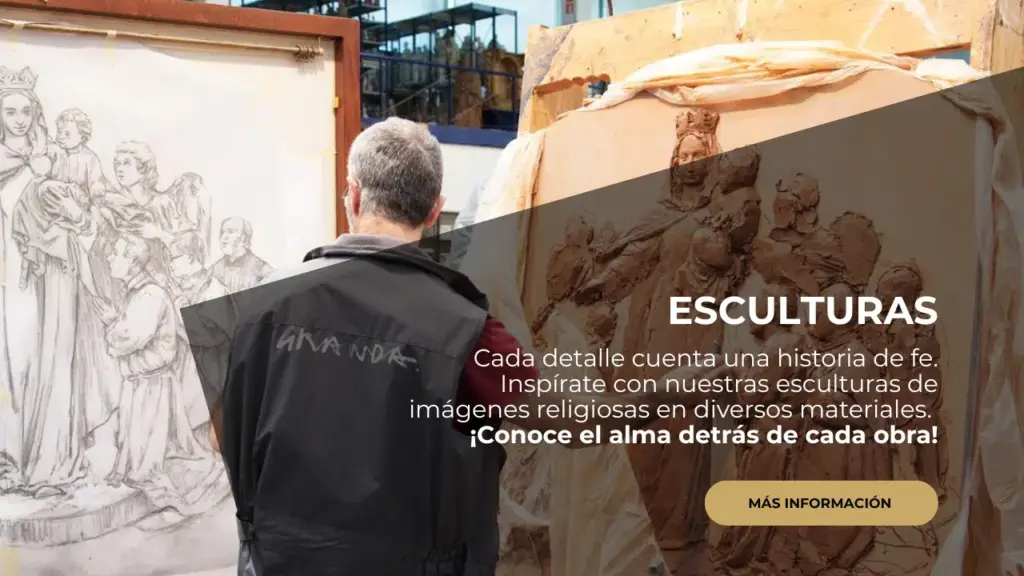
If your parish, chapel or institution wishes to incorporate a quality sculpture, made with noble materials and faithful to tradition, you can explore the collection and the international projects of sacred art and religious sculptures.
Each piece is the result of craftsmanship that combines faith, art and craft. Sacred beauty never goes out of fashion, because it remains the most universal language of all: the one that elevates the soul.

