


The Tabernacle It is the small chamber, usually made of gold- or silver-plated metal, where the Catholic Church keeps the Blessed Sacrament outside of Mass for Eucharistic adoration and to bring Communion to the sick. In any project for liturgical interior design, its location marks the spiritual axis around which the altar, the sanctuary, and the rest of the church are arranged, so that a member of the congregation recognizes, almost without thinking, where the real presence of Christ resides as soon as he or she enters through the door.
The terms sagrario, tabernacle y custody coexist in liturgical language, although they do not mean the same thing. The latter permanently preserves the consecrated forms, while the monstrance, also called ostensory, is used to display them through a manly made of glass during Eucharistic adoration or processions. Any project to liturgical interior design Anyone who strives for quality must start with this distinction before deciding on materials, lighting, or location.
The word "sagrario" comes from Latin sacrarium, a place consecrated or set aside for the sacred. Today, it serves a dual purpose within the temple. It houses the Eucharist with the solemnity and dignity that its contents demand, while at the same time quietly but consistently highlighting the spiritual center of the building. A church may have a splendid altar, a light-filled nave, and a magnificent altarpiece, but if the tabernacle is hidden or poorly designed, the entire structure loses its center of gravity.
▶ You may be interested in: The Tabernacle, monstrance of the sacred species, the center of Catholic worship.
The tabernacle did not always take the form of a fixed shrine as we know it today. Its evolution, from the earliest Eucharistic vessels to the permanent tabernacle that became widespread beginning in the Council of Trent, explains why current liturgical regulations are so strict regarding its placement and security. Each historical period—the shift to a fixed piece of furniture in the 15th century, the Baroque emphasis on the altarpiece, the possibility of having a dedicated chapel behind the Vatican Council II, made a specific demand that any project to liturgical interior design The current one must continue to be respected.
| 💡 Key fact. Liturgical regulations do not specify a single valid location for it. They permit both the sanctuary and a separate chapel, and within these two options, each liturgical interior design project must take into account the church’s architecture, the flow of visitors, and the customs of the diocese before making a decision. |
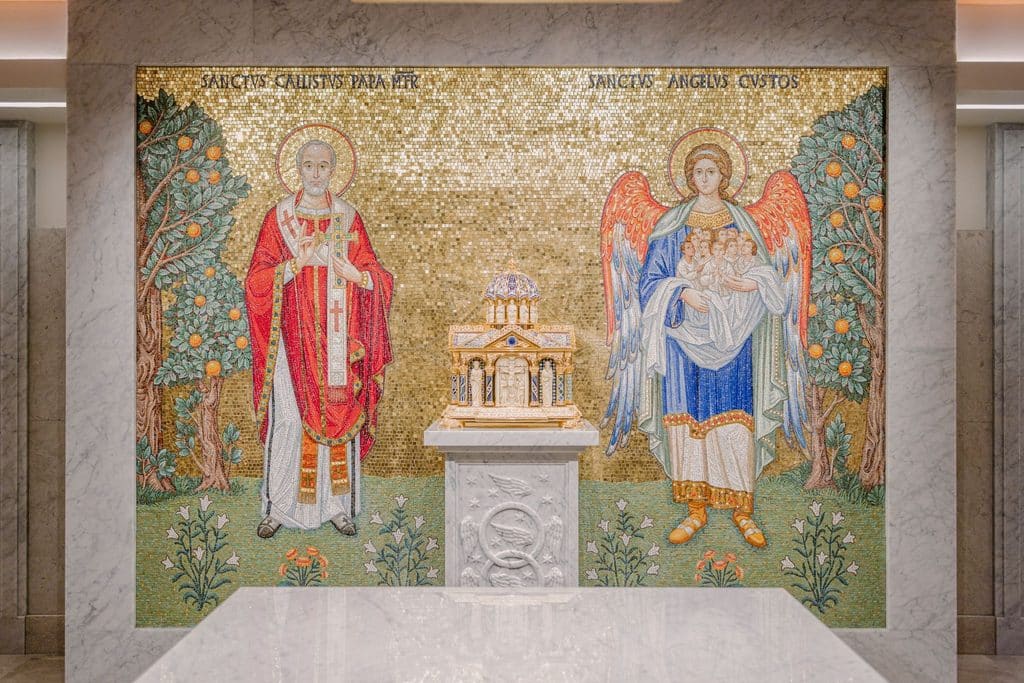
Choosing its location and building it is not a standalone decorative decision. It is part of a broader project to liturgical interior design which must harmonize canon law, the existing architecture, and the community's experience of prayer.
The General Introduction to the Roman Missal, in paragraphs 314 and 315, calls for the tabernacle to be placed in the most prominent part of the church, where it is visible and well adorned, and recommends that it not share the same altar where Mass is celebrated. It may be situated in the sanctuary, in an elevated and clearly visible position, or in a separate chapel connected to the rest of the church, as determined by the local diocesan bishop. Tradition adds a simple yet significant detail: a lamp, fueled by oil or wax, must always burn beside it, signaling from a distance that the presence of Christ resides there.
The same regulations require that it be unique, immovable, and made of solid, tamper-proof material that is not transparent and is sealed in such a way as to prevent any risk of desecration. In practice, this technical requirement translates into the work of goldsmiths and cabinetmakers who combine bronze, silver, fired enamels, and solid wood to create pieces that are both sturdy and beautiful. The interior is often embellished with 24-karat gold and reliefs depicting Eucharistic motifs, while the exterior protects the piece and presents it for worship.
Learn about the Complete catalog of Granda tabernacles to see the variety of finishes, sizes, and styles available.
A great liturgical interior design project It does not illuminate the tabernacle as if it were a museum display case. It seeks a subtle contrast that sets it apart without competing with the main altar, and it typically relies on a traditional lamp to maintain that constant presence even when the rest of the church is dark. Light that is too uniform flattens the space and leaves the eye unsure of where to look, while a well-calculated accent restores the tabernacle to its rightful, quiet prominence.
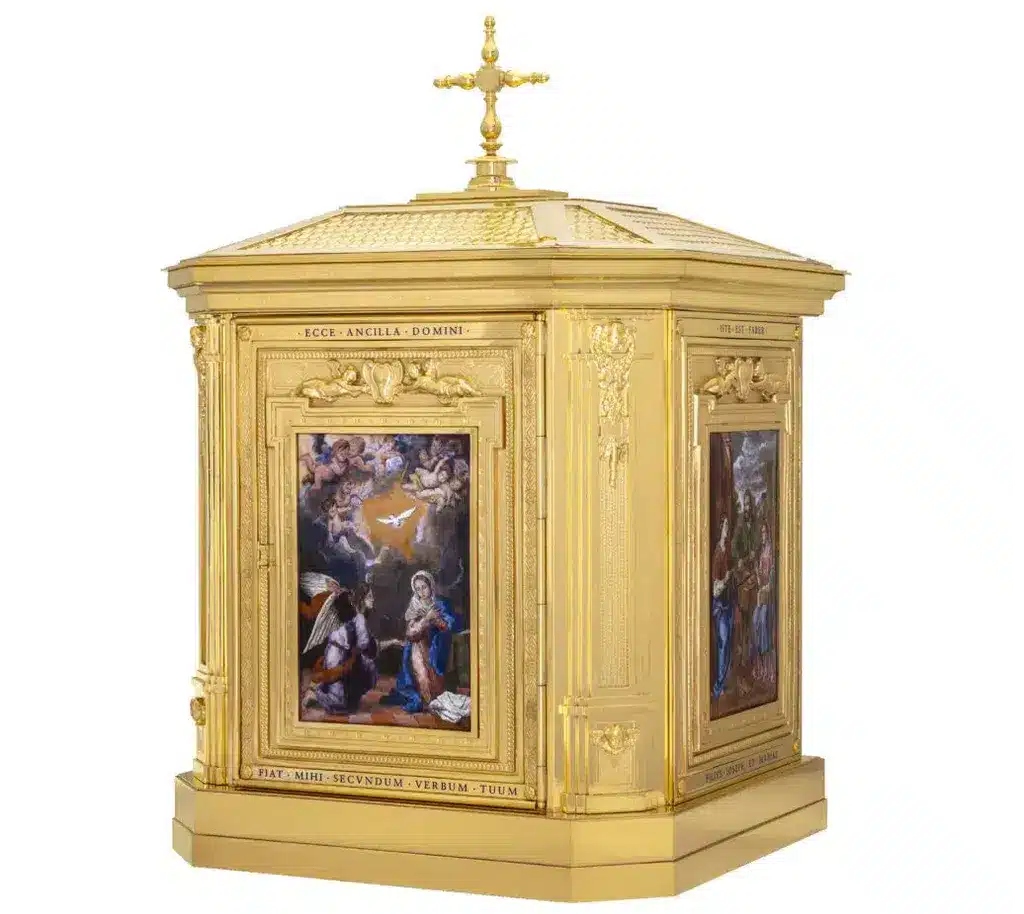
The best way to understand how liturgical norms coexist with artisanal creativity is to look at actual pieces. Here are some representative examples from the workshops of Granda, each designed for a different patron saint, setting, and community.
| How they handle it. None of these four models is a standard catalog item in the strict sense. Each parish may request variations in size, finish, or iconography, and for larger-scale projects, the design is tailored in collaboration with the architect or liturgical interior design firm responsible for the renovation, so that the tabernacle harmonizes with the rest of the sanctuary. |
| Style | Inspiration or Era | Characteristic Materials | Usual location | A real-life example from Granada |
| Mozarabic | Early medieval artifact from the 11th century | Gold- or silver-plated metal with Marian reliefs | Small chapels and oratories | Mozarabic-style reliquary |
| Gothic | 13th–15th Centuries | Wrought iron, enamel, angelic reliefs | Wall cabinet or altarpiece | Custom-made pieces based on exclusive designs |
| Baroque | 17th and 18th Centuries | Marble, gilded bronze, fired enamels | Center of the main altarpiece | Baroque tabernacle made of green marble |
| Neoclassical | 18th and 19th Centuries | Marble, bronze with clean lines | Chancel, central axis | Neoclassical tabernacle from the San José workshop |
| Contemporary | The 20th century and beyond | Bronze, hardwood, protected glass | Separate chapel or side chapel | Complete Catalog of Tabernacles |
This evolution shows that the tabernacle has never been a static element in terms of its form. What has remained constant throughout the ages is the desire to elevate its dignity above any passing fad.
Every well-designed sanctuary arranges its elements according to their function in the liturgy. The tabernacle occupies a specific place within that visual hierarchy, and it is important to keep a few points in mind when planning it.
It should be located in a prominent, visible place suitable for prayer—either in the sanctuary, away from the altar of celebration, or in a separate chapel that is organically connected to the rest of the church. The final decision rests with the diocesan bishop, who assesses the architecture of each church before making a decision.
Can the tabernacle be on the same altar where Mass is celebrated?
Liturgical guidelines discourage this for symbolic reasons, although they do not prohibit it outright. It is preferable to separate the altar where the celebration takes place from the place where the Eucharist is reserved so that each may clearly fulfill its own function.
The materials must be sturdy, tamper-proof, and opaque. Bronze, silver, and wrought iron have proven over the centuries that they withstand the test of time without losing their dignity or beauty.
The tabernacle is the receptacle where the Eucharist is permanently kept outside of Mass. The monstrance, also called an ostensory, is a piece of sacred metalwork—almost always featuring a glass canopy—used to display the Blessed Sacrament during Eucharistic adoration or in processions, such as the Corpus Christi procession.
The pyx is the oldest liturgical vessel, used since the early centuries to store small quantities of consecrated hosts, especially for the communion of the sick. The tabernacle, on the other hand, is a larger, fixed chamber that, since the 15th century, has served as a permanent repository within the church, although many parishes continue to use the pyx inside it as an immediate receptacle for the consecrated hosts.
At GRANDA Since 1891, we have been working alongside parishes, cathedrals, and religious communities to give tangible form to these spaces of prayer. We know that every tabernacle that leaves our workshops must stand the test of time for generations to come, which is why we work closely with architects, goldsmiths, and cabinetmakers before finalizing a single design. You can also visit our section on special works to view comprehensive, custom-designed sacred art projects.

