


The May 18, 2025, in the Sistine Chapel and among the cardinal electors, His Holiness Pope Leo XIV He was celebrating Holy Mass to mark the beginning of his pontificate.
At the moment of consecration, the Holy Father raised the chalice: a piece of original design that remains classic, on whose gilded cup stood out enamels of a beautiful translucent red color—which in the Spanish tradition of enamelwork was called rosicler.
The emotion of that moment was twofold for us as we recognized in that chalice the an unmistakable hallmark of the works from our workshops. The investigation identified the chalice as the one that The dioceses of Spain presented a gift to His Holiness Pius XI in 1929 on the occasion of his golden jubilee as a priest.
At GRANDA We are immensely fortunate—and have a great responsibility—to be a company already more than a century old dedicated to the mission for which it was founded and committed to its original values.
Ever since Mr. Félix Granda y Buylla devote himself to sacred art in 1891, immediately after his ordination to the priesthood, they have left our Art Workshops tens of thousands of liturgical works.
Our core values are attention to the liturgythe service to the Church and the handcrafted. Over time, many of these works have been forgotten, so it is always a special cause for joy when they resurface and continue to fulfill their liturgical function.
We never imagined that we would see, once again and so soon, a historic work from our Art Workshops in the Pope’s hands His Holiness Leo XIV. But we were overjoyed to learn that one of the pieces preserved at the Almudena Cathedral Museum had been the the monstrance chosen for the Corpus Christi procession in Madrid, during the Pope's first visit to Spain.
The very The Holy Father led a procession with the Blessed Sacrament in it, thereby lending exceptional historical significance to this piece, which has been preserved for decades in the Madrid cathedral.
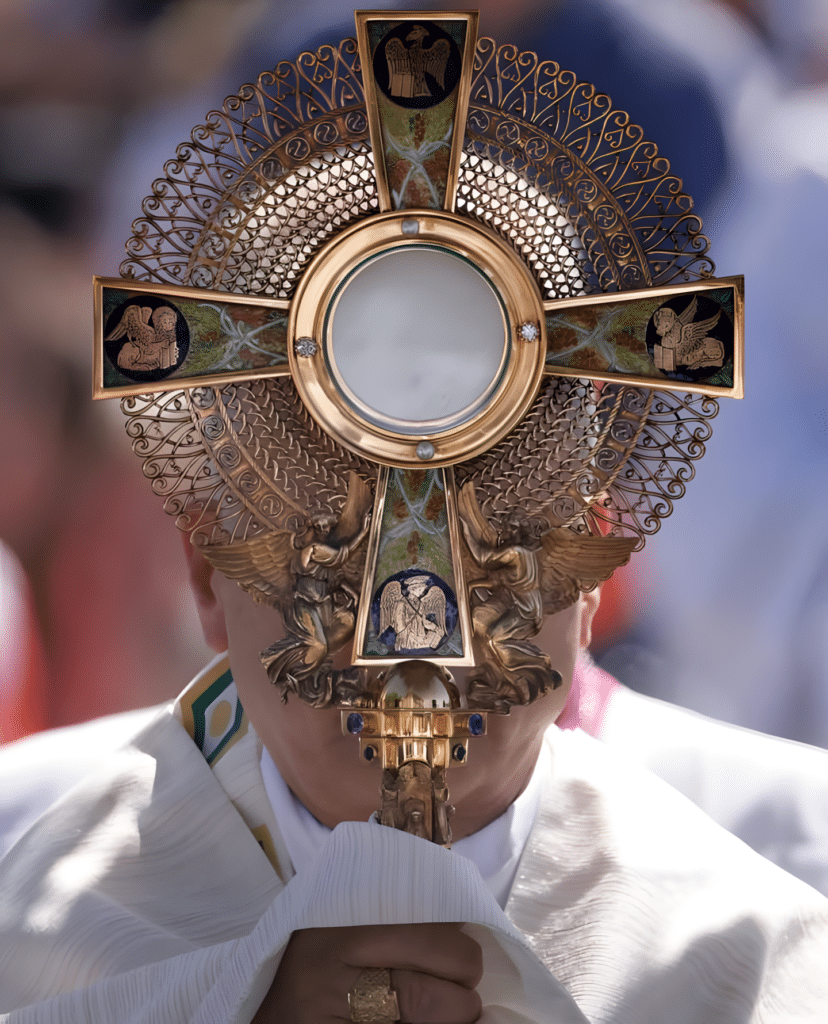
Unlike the chalice of His Holiness Pius XI, the monstrance preserved in the Almudena Cathedral was a modest piece, created in 1943 for the chapel of the Sagrada Familia School in Vallehermoso—which is now the Teatro de la Abadía and was then administered by the Madrid Provincial Child Protection Board.
Those unfamiliar with our company's history might not notice that modesty. This case reveals the care that Mr. Felix Granda he bestowed upon all liturgical works: even when financial circumstances called for a simpler design, all the works always had a sufficient quality in its materials, craftsmanship, and beauty.
The Sagrada Familia School It was built after the Civil War on the site where the shelter and school run by the Daughters of Charity had once stood. It was run by the Madrid Provincial Board for the Protection of Minors and its chapel was designed by the architect José María de la Vega y Samper.
Although the project description published in the National Architecture Magazine (No. 39, Mar. 1945, pp. 85–91) The Art Workshops are not mentioned; the photographs in the article show liturgical furnishings and images, all of which are well-known models from our company.
The chapel was closed in 1977 and was later converted into the current Teatro de la Abadía.
We do not know the details of that commission today, since they have not yet been researched and are now part of history.
The The workshops' output is immense and very little documentation has been preserved, especially from the postwar years. It is estimated that Between 1939 and 1952 alone, around 10,000 works were created, between projects and objects.
One distinctive feature was to introduce changes in the designs each time they were made: even when starting with the same model, the result was always unique. In this case, the starting point was a model whose most notable example is the the reliquary of the Nocturnal Adoration of Oviedo, housed at the Oviedo Cathedral Museum, created in 1922.
The version created for the Vallehermoso school preserves the beauty and dignity of the original design, even though it features decorative simplifications typical of the years of scarcity and rationing after the Civil War.
The case was made from gilded silver, chiseled and embossed, with vegetation at its base, and simply decorated with pearls, diamonds, amethysts, and enamel, the latter of which were likely donated.
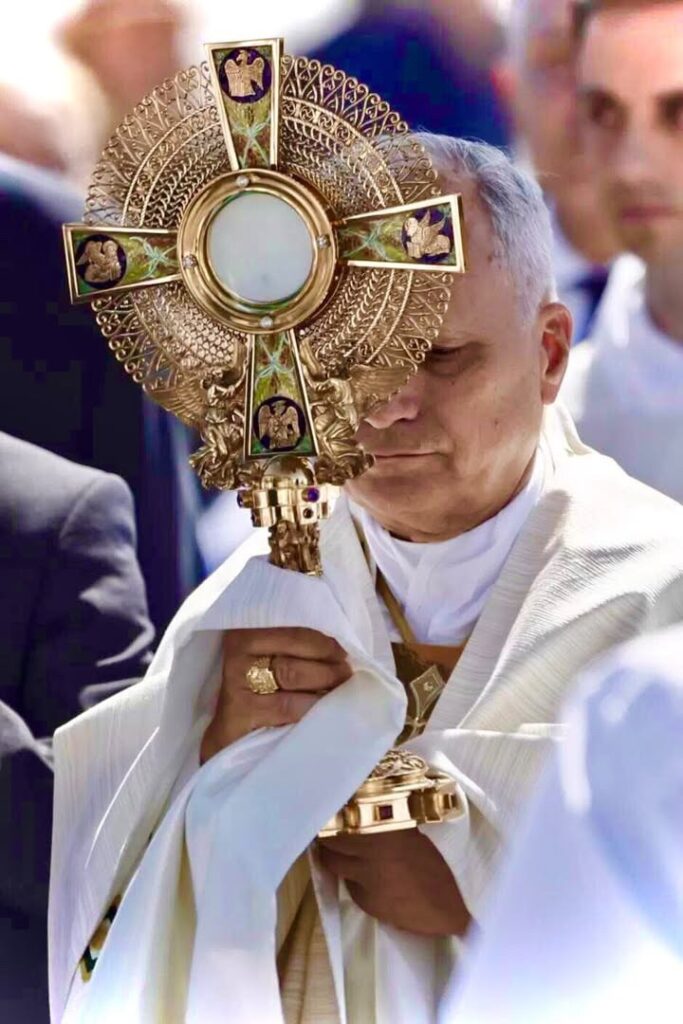
The base of the monstrance carried by the Pope features a embossed decoration featuring intertwined ribbon motifs, foliage, and birds. For Félix Granda, the flowers and fruits depicted on liturgical objects expressed the the joy with which the altar is decorated and the promise of an eternal spring.
He drew inspiration for this performance from the verses of Saint Paulinus of Nola (Poem XIV, On the Birthday of St. Felice, Poem III):
«Sing, children, your praises to the Lord, and gathered in your holy choirs, intone your songs of joy. Scatter your flowers across the earth and adorn the doorways with garlands. Let winter breathe life into the splendor of spring, and let the year blossom before its time.»
Birds, for their part, usually represent the immortal souls of the faithful.
The The shaft of the Pope's monstrance is decorated with figures of angels and is topped by half sphere which serves as the base for the head. Although this sphere is not decorated in the Vallehermoso reliquary, in other versions of the model it represents the sphere of the Universe, that is, the Cosmos depicted as the footstool of the Throne of the Lamb.
Two angels in relief appear to be holding the a kick to the head, in whose arms—adorned with translucent and champlevé enamels— it features roundel depictions of the Tetramorphs. The dashes are replaced by a delicate openwork ornamentation made from twisted silver wire.
In the Almudena Cathedral Museum Other significant historical works from our company have been preserved. Among them are:
- The chalice used in the wedding ceremony of Their Majesties King Felipe VI and Queen Letizia.
- The monstrance from the Nocturnal Adoration in Madrid, another iconic piece from our workshops.
Both pieces are a testament to the The Continuity and Relevance of the GRANDA Art Workshops throughout more than a century of liturgical history in Spain.

